To make up for the privacy issues of bedroom monitoring with cameras, bio-radar: a new option for bedroom home health and safety monitoring
In the field of smart home and health monitoring, cameras and bio-radar are both highly regarded technologies. However, the installation of cameras in private spaces such as bedrooms often raises concerns about privacy protection. In contrast, bio-radar, as a non-contact vital sign detection technology, provides a more privacy-friendly and efficient solution for bedroom home health and safety monitoring.
1. Challenges of installing cameras in bedrooms
As an intuitive visual monitoring tool, cameras are widely used in home security and health monitoring. However, when cameras are installed in private spaces such as bedrooms, their shooting range often covers the user's daily life and private life, which inevitably raises concerns about privacy protection. Although many camera products are equipped with privacy protection functions such as physical blocking and motion detection alarms, these measures cannot completely eliminate users' concerns about privacy leaks.
2. Advantages of Bioradar Technology
Bio-radar technology, with its unique advantages, provides a new option for bedroom home health and safety monitoring. Bio-radar senses the vital signs of the human body, such as breathing, heartbeat and body movement, by emitting and receiving radar waves, thus achieving non-contact, non-perceptual continuous dynamic monitoring.
Non-contact monitoring:Bio-radar does not need to come into direct contact with the human body, avoiding the discomfort and limitations of traditional monitoring methods. In private spaces such as bedrooms, this non-contact monitoring method can protect the user's privacy to the greatest extent.
High precision and high stability: Bioradar technology has high precision and high stability, can accurately sense the vital characteristics of the human body, and provide reliable data support for health monitoring.
Multi-scenario application: Bioradar is not only suitable for home health and safety monitoring in bedrooms, but can also be widely used in nursing homes, judicial surveillance and other fields, showing strong application potential.
3. Application of bio-radar in bedroom home health and safety monitoring
Sleep monitoring:The bio-radar can penetrate clothing, bedding and other media to monitor the human body's breathing and body movements in real time. By analyzing these data, the user's sleep state, such as deep sleep, light sleep, wakefulness, etc., can be evaluated, providing a scientific basis for improving sleep quality.
Fall warning:For the elderly or those with limited mobility, falling is a common safety hazard. Bio-radar can monitor human body movements in real time. Once an abnormal body movement pattern (such as a fall) is detected, an early warning mechanism can be triggered immediately to alert family members or caregivers to provide timely rescue.
Vital Signs Monitoring: In addition to sleep monitoring and fall warning, the bio-radar can also monitor the body's vital signs such as breathing and heartbeat in real time. These data are of great significance for assessing the user's health status and timely discovering potential health problems.
4. Future Development of Bioradar Technology
With the continuous development and improvement of bio-radar technology, its application prospects in the field of bedroom home health and safety monitoring will be broader. In the future, bio-radar technology is expected to achieve interconnection and interoperability with more smart devices and combine with data analysis technology to provide users with more comprehensive and personalized health management services. For example, bio-radar can be linked with smart mattresses, smart air conditioners and other equipment to automatically adjust the indoor environment according to the user's sleep status and health data to create a more comfortable and healthy sleeping environment.
V. Conclusion
As a privacy-friendly, efficient and convenient means of health monitoring, bio-radar technology is gradually changing the pattern of bedroom home health and safety monitoring. With the continuous advancement of technology and the continuous expansion of application scenarios, bio-radar will provide people with more comprehensive and personalized health management services, allowing technology to better serve human health and life.
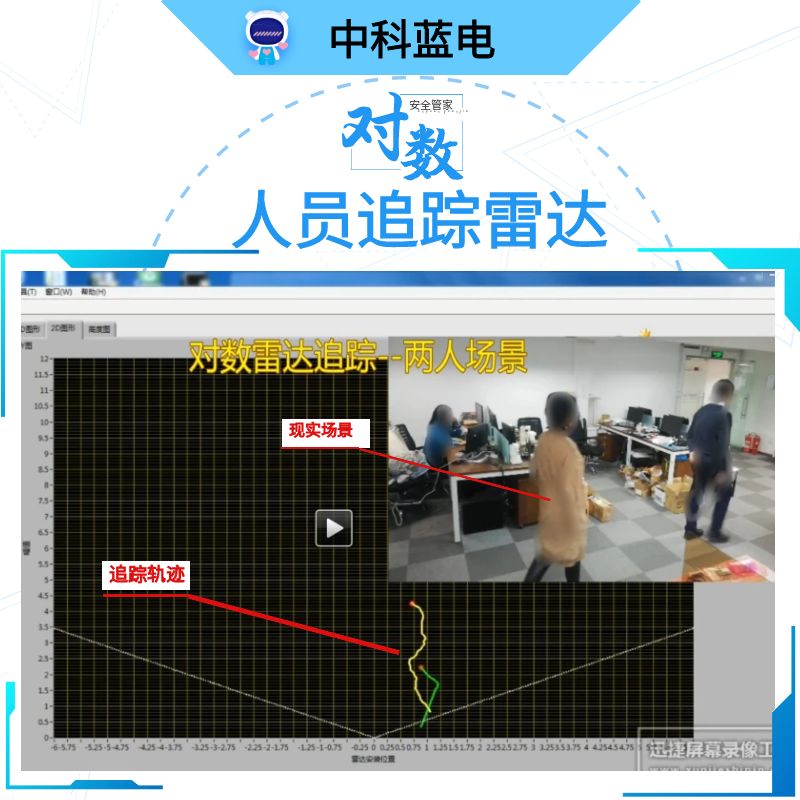
The human trajectory tracking radar is a device based on radar technology, which is mainly used to monitor and track the movement trajectory of people in a specific area in real time. The following is a detailed introduction to the human trajectory tracking radar:
1. Working Principle
The human trajectory tracking radar detects the position and movement status of the target object by emitting electromagnetic waves and receiving the reflected signals. When the electromagnetic waves encounter the target object such as the human body, they will be reflected. After the radar receives the reflected signal, it can determine the distance, speed, direction and other information of the target object through signal processing and analysis, thereby realizing the tracking of the human trajectory.
2. Main features
Non-contact detection: Personnel trajectory tracking radar does not need to have direct contact with the detected object and can perform detection without infringing on personal privacy.
High-precision positioning: Using advanced signal processing technology and algorithms, the radar can achieve high-precision target positioning and trajectory tracking.
Working around the clock: Not affected by lighting conditions, obstacles and other factors, the radar can work stably in various environments.
Real-time: Radar can output detection results in real time and provide timely information support for decision-making.
People tracking radar has a wide range of applications, mainly involving scenarios that require real-time monitoring and tracking of people's activities. The following are some specific application examples:
Intelligent security monitoring:
In public places such as airports, train stations, subway stations, shopping malls, etc., people tracking radar can monitor the flow of people in real time, prevent criminal activities, and improve security.
In special places such as prisons and detention centers, radars can monitor prisoners' movements to ensure safe supervision.
Smart elderly care and health care:
In nursing homes or home environments, radar can track the activities of the elderly and promptly detect abnormal behaviors such as falls and getting lost, providing timely assistance to the elderly.
For patients who require special care, radar can monitor their movements to ensure they receive appropriate care.
Smart Retail and Customer Analysis:
In retail locations such as shopping malls and supermarkets, radar can track customers’ movements within the store, analyze customer behavior, and optimize merchandise display and marketing strategies.
By understanding customers' shopping habits and preferences, merchants can provide more personalized services and product recommendations.
Smart Building and Home Automation:
In smart buildings, radar can monitor the activities of people and automatically adjust lighting, air conditioning and other systems to improve energy efficiency.
In a smart home, radar can track the activities of family members and realize intelligent home control, such as automatically turning on and off lights and adjusting room temperature.
Emergency Relief and Disaster Response:
At disaster sites such as fires and earthquakes, radar can quickly locate trapped people and provide key information for rescue operations.
In dangerous environments such as mines and tunnels, radar can monitor the activities of people and ensure their safety.
Sports and sports analysis:
During sports training and competitions, radar can track athletes' movements, analyze their technical movements and performance, and provide feedback and improvement suggestions to coaches and athletes.
Traffic management and optimization:
At transportation hubs such as airports and train stations, radar can monitor the flow of people and vehicles, provide real-time data support for traffic management, and optimize traffic flow.
The application of human trajectory tracking radar is constantly expanding. With the continuous advancement of technology and the reduction of costs, it will play an important role in more fields and improve people's quality of life and safety. At the same time, it is also necessary to pay attention to protecting personal privacy and data security to ensure the legal and compliant use of technology.
Take perception radar as an example. This radar can accurately locate and track objects by measuring the echo time and direction of the signal. It has the functions of detecting the presence of people, the number of people, the trajectory of people, and the coordinates of people. Compared with traditional infrared and other detection methods, it has low false alarms and missed alarms, and can accurately depict the trajectory and number of people. In smart homes, this radar can control the underfloor heating system, determine whether there is someone in the room, and turn the heating on or off accordingly; it can also track the distance and position of people in the room to adjust the fan speed of the fresh air system and the blade direction of the room air conditioner to improve the comfort of the residents.
In short, personnel trajectory tracking radar is a technical device with broad application prospects, and will play an important role in smart security, smart elderly care, smart home and other fields.