
What are the components of radar-type river water level monitoring stations and irrigation area flow monitoring stations?
Radar river water level monitoring station
The radar river water level monitoring station is mainly composed of the following parts:
Radar water level gauge:As the core equipment, it measures the height of the river surface by emitting radar waves to the river surface and receiving its reflected signals. The radar water level meter has the advantages of high measurement accuracy, good stability and little impact from the environment.
Data acquisition and transmission system:Responsible for collecting the water level data measured by the radar water level meter in real time and transmitting it to the central server wirelessly or wiredly. This system ensures the accuracy and real-time nature of the data.
Central Server:As a data processing center, it receives and stores water level data sent from the data acquisition and transmission system. At the same time, the central server is also responsible for processing and analyzing the data, generating corresponding reports and charts, and providing decision support for river management.
Alarm system:Real-time monitoring of water level data based on preset thresholds. When the water level exceeds or falls below the threshold, the alarm system will immediately trigger the alarm mechanism and send alarm information to relevant personnel so that timely response measures can be taken.
Power supply system:Provide stable power support for the entire monitoring station, usually using a combination of solar panels and batteries, which not only ensures a continuous supply of electricity but also reduces operating costs.
Irrigation area flow monitoring station
The irrigation area flow monitoring station is mainly composed of the following parts:
sensor:Including water level meter, flow meter, rain gauge, etc., used to measure the water level, flow velocity, rainfall and other data of the channel. Among them, the water level meter usually adopts ultrasonic water level meter or float water level meter, and the flow meter adopts Doppler ultrasonic flow meter or radar flow meter.
Data Logger:Responsible for collecting sensor data and transmitting the data to the remote monitoring center. This type of equipment usually uses a remote measurement terminal (RTU), which can process, store and transmit the collected data.
Communication Network:Used to transmit data from the site to the remote monitoring center. Usually GPRS/GSM, CDMA, 4G and other wireless communication networks are used to transmit data to the cloud server.
Remote Monitoring Center:Includes cloud servers, data receiving software and other equipment to receive, store and process transmitted data. The remote monitoring center can monitor the water level, flow rate, rainfall and other data of the irrigation area in real time, conduct statistical analysis on these data, and provide functions such as alarm and prediction.
Display Devices:Used to display data such as water level, flow rate, rainfall, etc. in irrigation areas. Usually using electronic devices such as computers and mobile phones, users can view real-time and historical data through browsers or applications.
In addition, some advanced irrigation flow monitoring stations may also include lightning protection equipment, solar power supply systems, etc. to improve the stability and reliability of the system.
In general, radar-type river water level monitoring stations and irrigation area flow monitoring stations each have unique components that work together to achieve accurate hydrological monitoring and data analysis, providing important technical support for water resources management.
How to install a river or irrigation area flow monitoring station?
The installation of a river or irrigation area flow monitoring station requires comprehensive consideration of multiple factors, including site selection, installation location, installation height and direction, safety protection and lightning protection measures, environmental considerations and cleaning, commissioning and calibration, and data transmission and maintenance. The following is a detailed installation guide: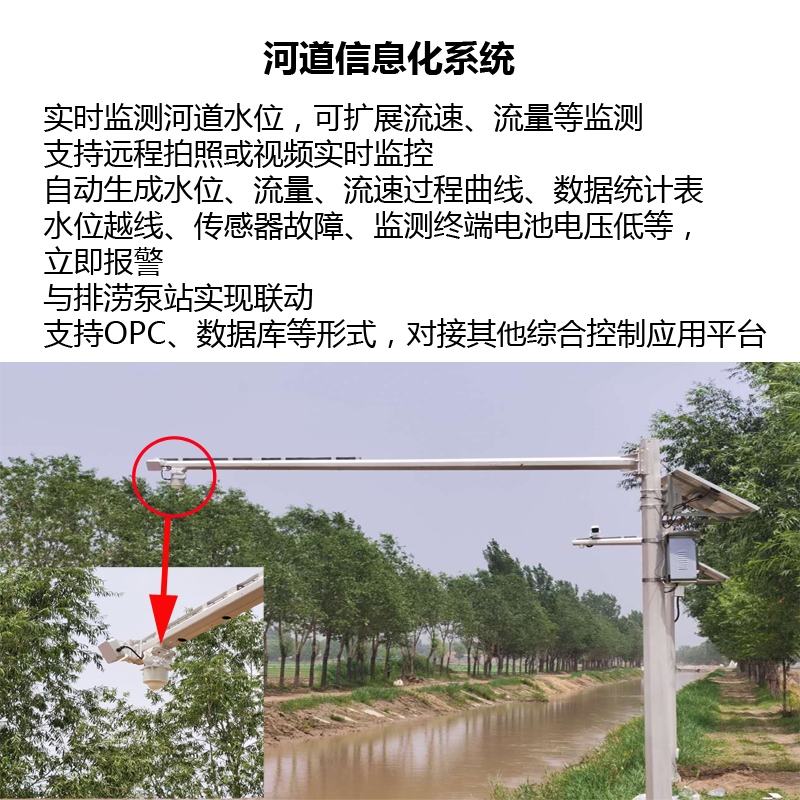
1. Preparation before installation
Site Investigation:
Conduct on-site surveys of rivers or irrigation areas to understand the river’s geographical environment, water flow conditions, water level variation range, etc.
Choose a suitable installation location according to the measurement purpose and requirements. Generally speaking, you should choose a location with steady water flow, stable riverbed, no obvious vortex and backflow, and avoid installing it in special locations such as curved river sections and tributary entrances.
Material preparation:
According to the type of flow measurement system and installation requirements, prepare the required materials and tools, such as sensors, cables, brackets, screws, etc.
Prepare the protective equipment required for installation, such as gloves, safety shoes, protective glasses, etc.
2. Installation steps
Mounting bracket and pole:
According to the actual situation of the installation location, select appropriate mounting brackets and poles. The brackets and poles should be stable and reliable, and able to withstand the weight of the equipment and the impact of water flow.
Use expansion screws or other fixing methods to fix the brackets and poles to the riverbed or river bank.
Installing the sensor:
According to the type of flow measurement system, choose the appropriate sensor installation method. Common sensor installation methods include fixed, suspended and traveling.
For fixed sensors, fix the sensor on a bracket or pole, making sure the sensor is perpendicular to the water flow direction and is securely installed.
For suspended sensors, suspend the sensor from a buoy in the water, ensuring that the sensor's position is stable and not affected by water currents.
For a walking sensor, install the sensor on the survey vessel, making sure the sensor is securely connected to the hull and can accurately measure the water velocity.
Connecting cables:
Connect the cable between the sensor and the data logger or controller. Make sure the cable is firmly connected and has good waterproof performance.
Pass the cables through cantilever steel pipes or take other protective measures to prevent rain or water flow from damaging the cables.
Installing a data logger or controller:
According to the type of flow measurement system, choose the appropriate data logger or controller installation method. Generally speaking, the data logger or controller can be installed in a control box indoors or in a waterproof box outdoors.
During installation, ensure that the location of the data logger or controller is stable and can be easily operated and maintained.
3. Post-installation debugging and maintenance
System debugging:
After installation, the flow measurement system is debugged, including checking the measurement accuracy of the sensor, the working status of the data logger or controller, and whether the communication connection is normal.
If any problems are found, they should be adjusted and repaired in time until the system can work normally again.
Regular calibration:
Regularly calibrate and verify the flow measurement system to ensure the accuracy and reliability of the measurement results. You can use standard equipment to calibrate the sensor or compare the measurement results with other reliable data sources.
Daily maintenance:
Regularly inspect and maintain the flow measurement system, including checking the working status of the sensor, the connection of the cable, the operation of the data logger or controller, etc.
Clean and maintain the sensor regularly to prevent the sensor surface from being covered or corroded by debris. The sensor can be cleaned with clean water or a special cleaning agent.
Pay attention to check whether there is silt or debris accumulation in the measuring area. If necessary, clean it up to keep the measuring area clean.
Safety protection:
During the installation and maintenance process, you should strictly abide by the safety operating procedures and wear personal protective equipment.
Take lightning protection measures to ensure that the grounding resistance meets the requirements of relevant standards to protect equipment from lightning.
Data transmission and maintenance:
Arrange data transmission lines reasonably to avoid being affected by water flow, animal damage or other external factors. Use waterproof and corrosion-resistant cables and fix and protect them properly.
Regularly check the connection status of data transmission lines to ensure the stability and reliability of data transmission.
Through the above steps, the correct installation and stable operation of the river or irrigation area flow monitoring station can be ensured. In actual operation, it is also necessary to adjust and optimize according to the specific equipment model and installation environment.